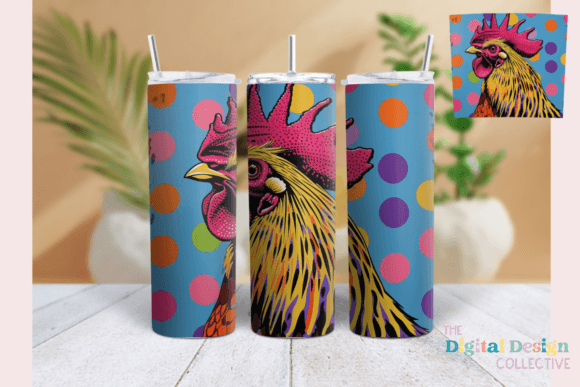
20oz Skinny Tumbler Wrap Pop Art Rooster
First Impressions: Bold, Playful, and Instantly Recognizable
When I opened the 20oz Skinny Tumbler Wrap Pop Art Rooster, my immediate reaction was a grin—this isn’t just another rooster motif. It’s got that punchy, mid-century pop art energy: high-contrast shapes, clean outlines, and stylized confidence. The composition is built for vertical impact—tall, lean, and balanced—so it reads clearly even at smaller scales. As an embroidery designer who’s stitched hundreds of animal motifs, I appreciate how the feathers, comb, and eye are simplified without losing personality. It doesn’t rely on photorealism; instead, it leans into graphic strength—which translates beautifully to stitch.
A Real Project Test: Embroidering It onto a Linen-Cotton Apron
Last week, I used the 20oz Skinny Tumbler Wrap Pop Art Rooster as the centerpiece for a custom apron order from a local café owner. She wanted something cheerful but not cutesy—something that said “handmade with care” but also held up under daily wear. I resized the design to fit a 4" × 6" hoop, digitized it as a satin-stitch outline with strategic fill-stitch accents (no dense fills—this isn’t a logo meant for heavy coverage), and stitched it onto medium-weight linen-cotton blend. The result? Crisp lines, no thread nesting, and zero distortion—even across the slight curve of the apron’s pocket edge. Customers noticed it immediately. One guest asked where she could buy one. That’s the kind of quiet credibility this design delivers.
Where It Shines—and Where It Needs Thought
The 20oz Skinny Tumbler Wrap Pop Art Rooster works exceptionally well on structured, stable fabrics: denim jackets, canvas tote bags, cotton sweatshirts, tea towels, and baby onesies. Its bold silhouette holds up on dark fabric when paired with bright thread (think tangerine or cobalt), and its minimal internal detail means it stitches cleanly even on lightweight knits—provided you use cutaway stabilizer underneath.
That said, avoid forcing it onto highly textured surfaces like bouclé or thick terry cloth—the clean lines will blur. Skip it for curved cap fronts unless you’re using a specialized cap frame and have tested stitch pull on scrap first. And while the rooster’s eye and beak are legible in PNG form, they’re *not* embroidered details out of the box—you’ll need to digitize them thoughtfully if stitching realism matters to your brand. This is a graphics file, not a machine embroidery design, so treat it as raw design assets—not plug-and-play stitch data.
Commercial Use Considerations for Craft Businesses
If you’re an Etsy seller or small shop owner building a cohesive collection—say, a “Farmhouse Pop” line of embroidered kitchen towels, pillow covers, and baby bibs—the 20oz Skinny Tumbler Wrap Pop Art Rooster serves as strong visual anchor. Its style bridges retro charm and modern simplicity, making it easy to pair with coordinating typography or geometric borders. But remember: because it’s delivered as PNG only, you’ll need to digitize it yourself (or hire a digitizer) before embroidering. Licensing isn’t stated in the product description, so verify usage rights before selling finished products or bundling it into digital embroidery kits.
I’ve seen sellers misstep by assuming PNG = ready-to-stitch. Don’t skip the prep. Digitizing this well means preserving its graphic integrity—keeping outlines sharp, avoiding overfilling the tail feathers, and adjusting stitch direction to follow the rooster’s flow. A poorly digitized version loses all its charm.
Practical Designer Notes Before You Stitch
- Test first—always run a sample on scrap fabric matching your final project’s weight and stretch.
- Check thread color contrast—especially on light backgrounds. White-on-cream can vanish; try charcoal or brick red for depth.
- Review stitch density—dense fills trap moisture and stiffen fabric. Let the design breathe with open satin or running-stitch accents.
- Confirm hoop size—the original PNG is sized for tumblers, so scaling down for patches or baby items requires careful proportion checks.
- Inspect small details—zoom in on the beak tip and comb edges. If they’re too fine in the PNG, they’ll disappear when stitched unless reinforced digitally.
- Mock it up in black and white—this reveals value contrast issues before thread hits fabric.
- Use proper stabilizer—cutaway for knits, tear-away for stable wovens, and optional topping for nap-heavy fabrics like terrycloth.
- Verify dual-use intent—if selling finished items commercially, confirm whether the license permits resale of physical products made from this graphic.
Why It Builds Trust—Not Just Visual Appeal
In handmade markets, customers don’t just buy a rooster—they buy intention. The 20oz Skinny Tumbler Wrap Pop Art Rooster signals thoughtful curation. It feels intentional, not algorithm-generated. When stitched cleanly onto a holiday gift towel or boutique sweatshirt, it elevates perceived value—not because it’s complex, but because it’s confident in its simplicity. That confidence transfers to your brand. Buyers remember clarity. They trust consistency. And they return for more when every embroidered piece feels like part of a considered world—not a random download.
Final Thought: A Design That Earns Its Place
This isn’t background filler. The 20oz Skinny Tumbler Wrap Pop Art Rooster demands attention—but politely. It fits seamlessly into projects where personality matters: personalized baby gifts, craft fair merch, café-branded aprons, or even embroidered patches for scout troops wanting vintage flair. It’s versatile without being vague, bold without being loud, and graphic without feeling cold. As a working designer, I keep files like this in a “go-to character” folder—not because they’re easy, but because they’re reliable. Just remember: respect the file type, honor the fabric, and digitize with purpose. Then let that rooster strut.